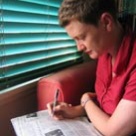
Each morning Barbara read newspaper reports covering events in the Middle East. She selected a prompt word or phrase that leapt from the page with generative potential. Photo: Glenn Stace.
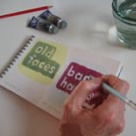
She rendered the prompt in watercolour and posted it to the site. Photo: Glenn Stace.
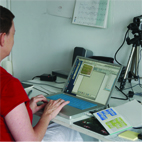
Each performance was broadcast live at sunset according to Barbara’s location. The first 99 performances were broadcast from the Power Institute of Fine Arts studio at the Cité des Arts Internationale, Paris. Photo: Mary Roberts
About the Project
In her durational performance, 1001 nights cast, Barbara Campbell cast a story into the ether every night for 1001 nights from 21 June 2005 to 17 March 2008. Each story had been written for her during the day by a pool of (by the end) 243 writers scattered across the globe. With only a few hours to write and a limit of 1001 words, each writer was responding to a writing prompt Campbell had extracted from one of that day’s newspaper stories about events in the Middle East. At sunset (according to Campbell’s location), she opened the live webstream on the 1001 nights cast website and told the new story to unseen audiences in unknown locations. The stories, as spoken, could only be witnessed in real time, but in text form, they remain on the website as ghosts of their one-time voicing.
Scheherazade and The 1001 Nights
1001 nights cast took its cue from that great compendium of Arabian tales: The 1001 nights also known as The Arabian nights.
The 1001 nights, Alf layla wa-layla, Les mille et une nuits: a title in constant motion, endlessly generating more and more versions of itself through translation, extension and expurgation. On your shelf there may sit a book with this title but it will not be the book. And on your book's cover there will be no author's name for it has been written by anonymous storytellers, spread over vast terrains and several centuries, made concrete by amanuenses and translators. The stories within will be set in 'the East' but you may never venture there yourself because this East exists in the kingdom of the fantastic that is called the imaginary. It is a land formed out of words and desires.
Yet for all its abstractions, this land does have borders. A frame story, told at the beginning and resurfacing at regular intervals, gives purpose and weight to all the other stories that follow. And further, this frame story comes with a terrible imperative. A young woman, Scheherazade, marries the despotic King Shahriyar, who, because of his first wife's infidelities, takes a succession of virgins to his bed, only to have each one killed the following morning. On her wedding night Scheherazade plots with her sister, Dunyazade, to entertain the king with a story that she does not finish when morning comes. Entranced and curious to hear the conclusion, the king forestalls Scheherazade's execution and when night approaches, the story continues, again without ending, and she sees another day. And so the pattern is set. Scheherazade narrates to keep herself alive, and by extension, the other young women of the kingdom who would surely have been killed as before. Eventually, after 1001 nights, the king's heart is softened. Scheherazade's reprieve is permanent.
1001 nights cast is a project generated by the forces of The 1001 nights: the theatrics of the voiced story, the need for framing devices, the strategies for survival, the allure of the Middle East and its contrasting realities.
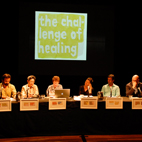
A symposium was hosted by the Performance Space at Carriageworks, Sydney on day 1000 (March 16, 2008). Speakers were (l. to r.) Matias Viegener (LA); Marian Pastor Roces (Manila/Perth); Helen Grace (Hong Kong); Barbara Campbell (Sydney); Tony White (London) and Frazer Ward (Northhampton, MA). Photo: Heidrun Löhr. Click here for London discussion hosted by Live Art Development Agency on 21 Sept 2007.
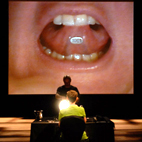
At the beginning of each webcast Barbara revealed the performance number stamped onto an individually-crafted tongue stud. Here she rehearses #1001 which was performed before a live audience on March 17, 2008 at Performance Space at Carriageworks. Photo: Heidrun Löhr.